WASHINGTON, DC — According to the U.S. Drug Enforcement Administration’s (DEA) data, it has funded the destruction of 4.7 billion non-psychoactive industrial hemp plants (also called “ditchweed“) since 1984. This massive annual eradication effort stands in sharp contrast to farmers across the globe continuing to legally produce industrial hemp for export to the United States.
According to data collected by the DEA’s Domestic Cannabis Eradication/Suppression Program (DCE/SP), 218.6 million ditchweed plants were eradicated nationwide in 2005 versus only 4.2 million marijuana plants. This means that 98.1% of all cannabis plants eradicated in 2005 were actually the non-drug variety of cannabis otherwise known as industrial hemp. Although the ditchweed is primarily being eradicated in mid-western states where it was once grown to support WWII efforts with the encouragement of the federal government, these plants would have little or no psychoactive effect on people who might smoke them because they contain very low levels of THC, the drug component in marijuana. Furthermore, George Weiblen, a researcher at the University of Minnesota, showed that marijuana and industrial hemp have distinct and non-overlapping DNA fingerprints. He published his findings in the March 2006 issue of the Journal of Forensic Science (volume 51, No. 2).
Table 1: Number of Ditchweed Plants Eradicated Over Time
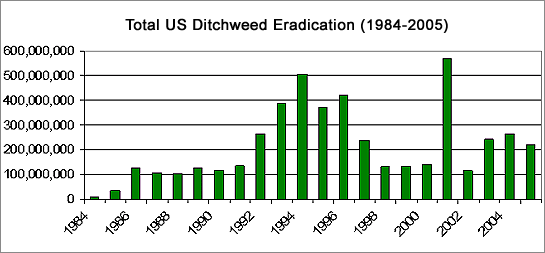
The massive ditchweed eradication program has cost federal and state governments at least $175 million since 1984, the earliest year data is available on ditchweed. The DEA spent $11 million in 2005 on DCE/SP grants to state police alone.
“It’s Orwellian that the biggest target of the DEA’s Eradication Program is actually not a drug but instead a plant useful for everything from food to clothing to even auto parts, which currently must be imported to supply a $270 million industry,” says Eric Steenstra, President of Vote Hemp. “While Vote Hemp has urged the DEA to recognize the difference between hemp and marijuana so farmers can grow it here, the federal agency is spending millions of dollars to destroy hundreds of millions of harmless hemp plants.”
How the DEA collects their own data on ditchweed, which is sometimes referred to as feral hemp, is puzzling because officials at the DEA regularly state there is no difference between hemp and marijuana. Nevertheless, their own statistics clearly differentiate between ditchweed and “cultivated marijuana” plants that are destroyed. Other questions loom over exactly what is happening to all these plants once they are eradicated.
“Much of the ditchweed eradicated is believed to be burned, turning a carbon consuming plant into a contributor of Greenhouse gasses,” says Tom Murphy, Vote Hemp National Outreach Coordinator. “For all the effort to find and destroy these harmless, wild hemp plants they are coming back year after year. It is likely that the eradication programs help re-seed the locations where ditchweed is found. The late summer timing and removal methods cause countless ripe seeds to fall to the ground where they will sprout again the following year.”
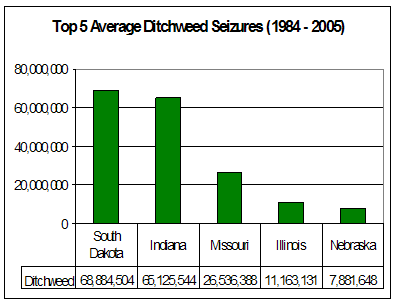
A nationwide leader, Indiana has eradicated, on average, 65 million wild hemp plants per year from 1984 through 2005, compared to the eradication of 114,699 cultivated marijuana plants per year in the same time period. Marijuana eradication requires that state police work overtime during the summer and wasted nearly 31,000 hours of officer’s time in each of 2003 and 2004, for example, accounting for 8.9% of the criminal related hours for the state police during those years. Ironically, FlexForm, an Indiana manufacturer whose hemp-content materials are found in an estimated 3 million vehicles in North America today, uses approximately 250,000 pounds of hemp fiber per year, which it must import from Canada and Europe. The company says industrial hemp could easily take a greater share of the 4 million pounds of natural fiber it uses yearly, as “hemp fiber possesses physical properties beneficial to our natural fiber-based composites.” In addition, FlexForm says it would “gladly expand domestic purchases.”
Table 2: Top 5 Average Ditchweed Seizures by State in Number of Plants
“The potential value of legal industrial hemp in rural economic development should be targeted for investment by the Department of Agriculture,” says Dr. Jon Gettman, a researcher in Public Policy and author of a new comprehensive report highlighting that marijuana valued at $35.8 billion is America’s number-one cash crop. “The multiple uses of industrial hemp in manufacturing and product innovation worldwide are consistent with current U.S. agricultural policies and a natural fit into many local economies around the nation.”
Numerous states are working to allow farmers to grow industrial hemp. Starting in January, North Dakota will accept applications from farmers to grow hemp. The race is on to bring the crop back due to increasing evidence hemp foods are becoming very popular. Sales of hemp foods in 2004/2005 grew by 50% over the previous 12-month period. U.S. retail sales of hemp products are now estimated to be $250 to $300 million per year. European farmers now grow more than 40,000 acres, and Canadian farmers grew almost 50,000 acres in 2006.
Seven states (Hawaii, Kentucky, Maine, Maryland, Montana, North Dakota and West Virginia) have changed their laws to give farmers an affirmative right to grow industrial hemp commercially or for research purposes.
###
Vote Hemp is a national non-profit organization dedicated to the acceptance of and a free market for industrial hemp and to changes in current law to allow U.S. farmers to once again grow hemp commercially.